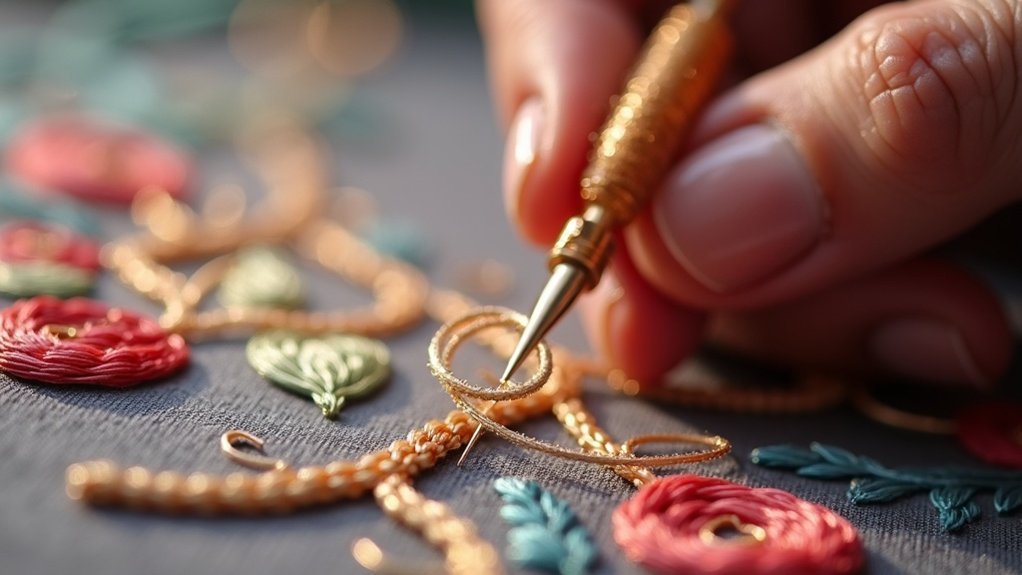
To manage metallic thread in embroidery, start by using a Topstitch needle (#90/14) to minimize friction and adjust your machine settings. Lower the top thread tension to around 1.0 and keep bobbin tension at its lowest for balanced results. Digitize designs to avoid sharp angles and dense areas, ensuring rounded shapes to reduce stress on threads. Remember to store threads properly and maintain your machine. Discover further techniques and tips for seamless metallic embroidery.
Key Takeaways
- Use a Topstitch needle (#90/14) to minimize friction and prevent thread breakage while stitching with metallic threads.
- Adjust top thread tension to around 1.0 and maintain bobbin tension at the lowest possible setting for optimal performance.
- Digitize designs specifically for metallic threads, avoiding sharp angles and reducing dense areas to minimize stress on the thread.
- Store metallic threads in a cool, dry place and use mesh net sleeves to prevent tangling and ensure quality.
- Regularly clean your machine and conduct tension tests on sample fabrics before starting projects to ensure smooth stitching.
Understanding Metallic Thread Types
When you immerse yourself in the world of metallic threads, it’s essential to understand the different types available to choose the right one for your project.
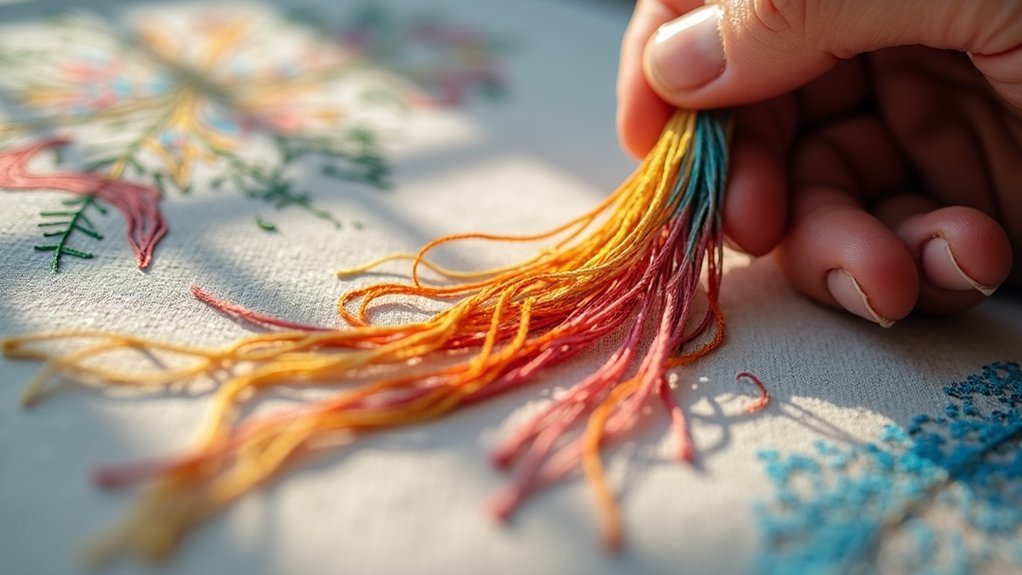
Metallic threads come in various forms, like DMC’s Light Effects collection, which offers vibrant colors. You’ll find six-stranded options that can be divided for unique effects.
Explore the vibrant hues of DMC’s Light Effects collection, featuring versatile six-stranded metallic threads for stunning stitching outcomes.
Au Ver a Soie provides quality metallic braids in multiple weights, catering to diverse stitching needs.
Consider whether you prefer core-wrapped or twisted threads, as smoother options perform better.
Don’t forget to select a Topstitch needle (#90/14) to minimize friction and protect your metallic threads during stitching.
Common Challenges With Metallic Threads
Although metallic threads can add stunning visual effects to your embroidery, they come with a set of challenges that can frustrate even experienced stitchers.
You might notice metallic thread breaks due to knotting, tangling, and the delicate nature of these threads, particularly on tightly woven fabrics. The outer layer may separate from the core, leading to fraying.
Additionally, tension issues are common; you’ll need to adjust both top tension and bobbin settings for best results.
Using shorter lengths of metallic thread can help minimize knotting and improve manageability while stitching for a smoother experience in your embroidery projects.
Preparing Your Machine for Metallic Embroidery
To prepare your machine for metallic embroidery, start by ensuring it’s clean and free of debris, focusing on thread guides and the bobbin case.
Next, choose a suitable needle, like a Topstitch #90/14, which will help minimize friction.
Finally, adjust the top thread tension to a lower setting, typically around 1.0, to protect the delicate metallic threads during stitching.
Machine Maintenance and Cleaning
Before diving into your metallic embroidery project, it’s vital to make certain your machine is in top condition. Regular machine maintenance is critical; clean the thread guides, bobbin case, and needle area to prevent tangling.
Confirm that all components, including the needle, are functioning properly to avoid complications. Inspect for obstructions that could lead to thread breakage or misalignment.
Use a Topstitch #90/14 needle specifically designed for metallic thread to minimize friction during high-speed stitching.
Finally, lubricate moving parts according to the manufacturer’s recommendations to guarantee smooth operation and enhance your embroidery experience.
Needle Selection Guidelines
Choosing the right needle is essential for successful metallic embroidery, and many experienced embroiderers recommend using a Topstitch #90/14 needle. This needle has a larger eye and deeper groove, minimizing friction and protecting delicate metallic strands. Always use new needles to prevent fraying and breakages, guaranteeing peak performance.
| Needle Type | Features | Recommendations |
|---|---|---|
| Topstitch #90/14 | Larger eye, deeper groove | Ideal for metallic threads |
| Regular Needles | Standard eye | Not recommended for metallic threads |
| Compatibility | Check manufacturer’s guidelines | Verify thread and needle match |
Monitor your needle condition, replacing it regularly for consistent stitching quality.
Tension Adjustment Techniques
While managing metallic threads in embroidery, adjusting the tension on your machine is essential for achieving flawless results.
Start by reducing the top thread tension to around 1.0 to prevent breakage and guarantee smooth stitching. Keep the bobbin tension at its usual setting but run it as low as possible to avoid pulling the thread out of the needle.
Regularly monitor and adjust these tension settings based on the specific type of metallic threads you’re using.
Always conduct tests on sample fabrics to confirm that your adjustments yield even stitching without fraying or breaking, understanding the relationship between top and bobbin tension.
Needle Selection for Metallic Threads
Selecting the right needle for metallic threads is essential to achieving a smooth and successful embroidery experience. Consider these recommendations for ideal needle selection:
- Use a Topstitch #90/14 needle for its larger eye and deeper groove, minimizing fraying.
- Avoid standard #75/11 embroidery needles, as they may cause breakage due to tightness.
- Opt for titanium-nitride coated Topstitch needles to reduce friction during high-speed stitching.
- Quilters Binding Needles work well too, featuring sharp points and large eyes to protect delicate fibers.
Regularly replacing needles guarantees your metallic threads perform at their best, preventing frustrating breakage while you serve your embroidery projects.
Adjusting Tension Settings for Success
When working with metallic threads, adjusting your tension settings is essential for achieving a successful stitch.
Start by reducing the top tension to around 1.0 and keep the bobbin tension at its lowest possible setting.
Always monitor the thread behavior during stitching and conduct tension tests on sample fabric to guarantee peak performance before beginning your project.
Optimal Tension Settings
To achieve successful embroidery with metallic threads, you’ll need to carefully adjust your machine’s tension settings.
Follow these guidelines for ideal tension settings:
- Reduce the top thread tension to around 1.0 to prevent breakage.
- Maintain the bobbin tension at its standard setting, keeping it low.
- Adjust tension based on your specific machine and thread type.
- Conduct test runs on sample fabrics to verify even stitching.
Monitor Thread Behavior
While managing metallic thread in embroidery, it’s vital to continuously monitor its behavior to guarantee the best results.
Adjust your bobbin tension to remain unchanged while running as low as possible for a smoother flow of metallic thread. Pay close attention to the top thread tension; it often needs to be lower than for polyester to prevent breakage and ensure even stitching.
Regularly check for signs of thread pulling out of the needle, indicating tension adjustments may be necessary. Remember, balanced top and bobbin tension is key to successfully managing metallic thread behavior during your embroidery projects.
Test on Sample Fabric
Before diving into your embroidery project, it’s essential to test on a sample fabric to verify your tension settings are spot on for the metallic thread you’re using.
Here are key adjustments to take into account:
- Lower the top thread tension to about 1.0 to prevent breakage.
- Keep the bobbin tension as low as possible without altering it.
- Adjust tension based on the thickness of the metallic thread.
- Experiment with different stitch densities and lengths for ideal results.
Stitching Techniques for Metallic Threads
When working with metallic threads, managing their unique properties is essential for achieving flawless results.
Use shorter thread lengths of about 18 inches to minimize knotting and tangling. Opt for a larger needle, like a Topstitch #90/14, to reduce friction and protect the delicate structure of the thread.
Adjust the machine’s tension, loosening it to around 1.0, to prevent breakage. Techniques like couching can help you control metallic strands, reducing twisting.
Always test on sample fabric to guarantee your chosen stitch density and design are compatible with the metallic thread, paving the way for beautiful, professional results.
Design Considerations for Metallic Embroidery
Managing metallic threads effectively sets the stage for thoughtful design considerations in embroidery.
Here are key factors to keep in mind:
- Adjust stitch density based on the thread thickness.
- Maintain a minimum stitch length of 3 mm for twisted metallic threads and 1 mm for standard threads.
- Design with rounded shapes and larger stitch lengths to minimize stress.
- Digitize specifically for metallic threads, avoiding sharp angles and dense areas.
Best Practices for Storing and Handling Metallic Threads
To guarantee your metallic threads remain in ideal condition, it’s essential to store and handle them with care. Keep them in a cool, dry place, away from sunlight, to prevent degradation. Use mesh net sleeves over cones to avoid tangles. Always keep threads wound tightly on their spools and organize them by color in a dedicated storage system. Regularly check and rotate older stocks to maintain usability.
| Storage Tip | Action | Benefit |
|---|---|---|
| Cool, Dry Place | Store away from light | Prevents fiber damage |
| Mesh Net Sleeves | Protect threads | guarantees smoother handling |
| Tightly Wound Spools | Avoid transferring | Reduces fraying risk |
| Organized by Color | Use storage system | Easy access |