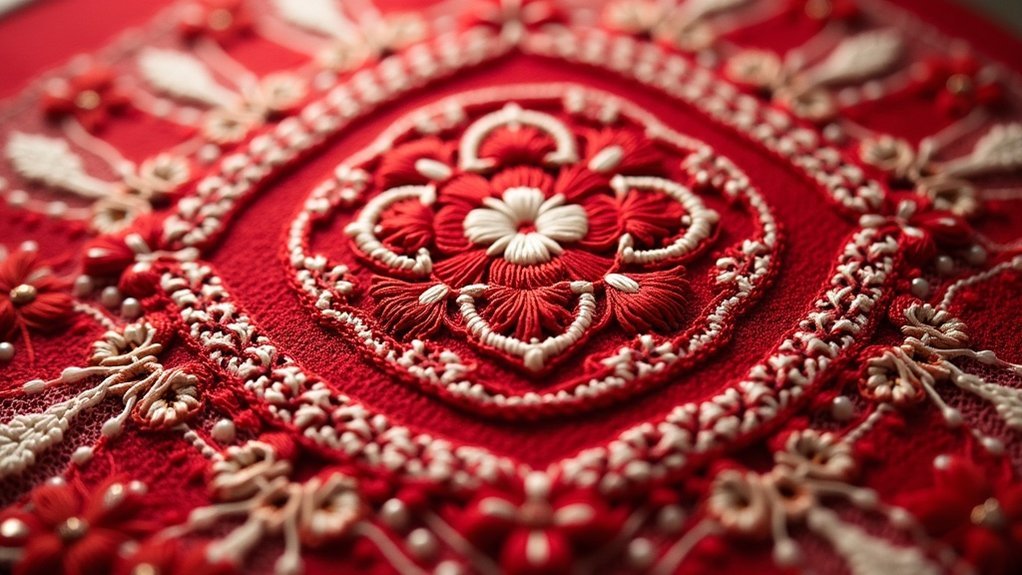
To identify Norwegian Hardanger embroidery, look for intricate geometric motifs and even-weave fabric. Key characteristics include foundational Kloster blocks, elegant Doves Eyes, and delicate cutwork techniques that create lacy patterns. The use of white or cream threads, usually made of pearl cotton, enhances the stitch precision and overall beauty. Pay attention to the decorative stitches and textures that enrich each piece. You’ll uncover even more fascinating details as you explore this beautiful craft further.
Key Takeaways
- Look for distinct geometric motifs that are central to Hardanger designs, often influenced by regional styles and family traditions.
- Identify the use of even-weave fabric, typically Hardanger fabric, which ensures precise stitch placement.
- Note the presence of Kloster blocks, which provide sturdy foundations for motifs and are created using solid satin stitches.
- Observe intricate cutwork techniques that remove threads to form delicate, lacy patterns secured with hemstitching.
- Recognize decorative stitch variations, such as Doves Eyes and Algerian Eye, which enhance the overall texture and beauty of the embroidery.
Historical Background of Hardanger Embroidery
Although Hardanger embroidery may seem like a purely aesthetic craft, its historical roots reveal a rich tapestry of cultural influences and evolution.
Originating in the Hardanger region of Norway, this traditional Hardanger technique traces back to the 7th century, influenced by Persian origins and Italian Renaissance styles like Reticella.
Originating in Norway’s Hardanger region, this embroidery technique reflects a blend of Persian and Italian Renaissance influences dating back to the 7th century.
By the 1650s to 1850s, it evolved from Norwegian Drawn Work into a community-favored art form. Gaining international recognition in 1900 at the Paris exposition, it showcased the artistry of Brita Skalveit.
Today, the history of Hardanger continues to thrive, especially among Norwegian immigrants preserving its cultural significance in the U.S.
Key Features of Hardanger Embroidery
When you explore Hardanger embroidery, you’ll notice its distinct geometric motifs, which form the backbone of its design.
The choice of even-weave fabric and white or cream threads enhances the precision of stitch placement and the overall texture, while various techniques like satin and blanket stitches add depth to the work.
Understanding these key features will help you appreciate the intricate artistry that defines this traditional craft.
Geometric Motifs and Patterns
Geometric motifs form the backbone of Hardanger embroidery, showcasing a rich tradition rooted in precision and artistry.
You’ll notice shapes like squares, rectangles, and eight-pointed stars meticulously arranged within a grid system, allowing for symmetry and balance. The foundation often includes Kloster blocks, which are solid satin stitches that support intricate cutwork.
Every pattern is unique, influenced by regional styles and family traditions, adding personal touches to the angular designs. To enhance the depth, additional stitches used in Hardanger, such as doves eyes and woven bars, further contribute to the visual complexity and texture of each piece.
Stitch Techniques and Textures
As you explore the world of Hardanger embroidery, you’ll find that the stitch techniques and textures play an essential role in bringing each design to life.
Central to this are Kloster blocks, which form sturdy foundations for intricate motifs and allow for cutwork, where threads are removed to create delicate patterns.
You’ll also encounter Doves Eyes, a charming motif created through needle weaving, enhancing the elegance of your work.
Incorporating decorative stitches like the Algerian Eye and Buttonhole stitches enriches the texture and visual appeal, making each piece not just a craft, but a heartfelt expression of artistry and care.
Fabric and Thread Choices
The fabric and thread choices you make in Hardanger embroidery greatly influence the outcome of your projects. Ideally, you should select even-weave fabric, preferably Hardanger fabric, with a thread count between 36 to 55 for precise stitch placement. Commonly, pearl cotton threads in white, cream, or natural gray are used. Thicker threads like Pearl 5 are perfect for foundational elements, while finer threads such as Pearl 8 and 12 are best for intricate designs.
| Fabric Type | Thread Type | Thread Count |
|---|---|---|
| Even-Weave Linen | Pearl Cotton | 36-55 |
| Hardanger Fabric | Linen | 36-55 |
| Cotton Fabric | Pearl 5 | 36-55 |
| Cotton Fabric | Pearl 8/12 | 36-55 |
Essential Materials for Hardanger Projects
Creating beautiful Hardanger embroidery requires a thoughtful selection of essential materials that greatly impact the quality and ease of your project.
Start with even-weave fabric like linen, ideally in counts of 36 to 55, for best results. For threads, use thicker Pearl cotton (size 5) for Kloster blocks and satin stitches, alongside finer sizes (8 and 12) for delicate details.
An embroidery hoop is crucial to maintain consistent tension, ensuring uniform stitches. Don’t forget sharp-pointed scissors for cutting threads during the hallmark cutwork process.
Finally, use tapestry needles in sizes 20, 22, and 24 to accommodate heavier threads effectively.
Common Stitches Used in Hardanger
When you explore Hardanger embroidery, you’ll quickly notice the importance of Kloster blocks, which form the backbone of the design with their solid satin stitches.
As you master cutwork techniques, you’ll learn how to create intricate lacy patterns by removing specific threads and securing them with basic stitches.
Additionally, decorative stitch variations like Doves Eyes and blanket stitches will elevate your work, offering both elegance and refinement to your embroidery pieces.
Kloster Blocks Overview
Kloster blocks form the backbone of Hardanger embroidery, serving as vital building blocks for intricate designs. Each block consists of four satin stitches arranged in a square, creating a grid that becomes the foundation for your work.
These blocks not only provide structure but also set the stage for drawn-thread techniques, which enhance the lace-like quality of your embroidery. As you master Kloster blocks, you’ll find opportunities to embellish them with additional satin stitches and Doves Eyes, adding depth and texture.
Understanding these elements is essential for beginners, opening the door to more complex Hardanger embroidery techniques and motifs.
Cutwork Techniques Explained
Cutwork techniques in Hardanger embroidery offer an enchanting way to transform basic fabric into intricate, lacy designs.
Mastering these techniques enhances your work’s beauty and stability. Here are three common elements to explore:
- Kloster stitch: This foundational stitch creates solid blocks, allowing you to cut threads safely within.
- Hemstitching: Employed alongside cutwork, it secures cut edges, adding further intricacy.
- Doves Eyes: A popular motif, these elegant shapes enrich your geometric patterns, infusing them with complexity.
Decorative Stitch Variations
Hardanger embroidery isn’t just about the foundational techniques like cutwork; it also thrives on a variety of decorative stitches that elevate its aesthetic appeal.
Kloster blocks, formed by satin stitches, create a sturdy base for these variations. Doves Eyes, woven circular motifs, add sophistication, while stitches like the Algerian Eye Stitch and Picot enhance intricate geometric designs.
Each decorative stitch contributes to the overall complexity and beauty of the piece, making your work stand out. By mastering these techniques, you’ll not only preserve tradition but also create stunning pieces that serve as lasting gifts for others.
Techniques for Creating Kloster Blocks
When you begin creating Kloster blocks, you’ll find that the technique hinges on mastering a series of satin stitches arranged in a square formation.
To guarantee your Kloster blocks stand out, focus on these techniques:
- Maintain Tension: Keep your fabric threads taut but not overly tight to prevent distortion.
- Count Carefully: Accurate counting is essential; miscounts disrupt the symmetry of your design.
- Enhance with Woven Bars: After stitching, connect blocks with woven bars for a cohesive geometric pattern.
Understanding Cutwork in Hardanger
While you might initially think of embroidery as simply stitching on fabric, understanding cutwork reveals a fascinating layer of creativity and technique.
In Hardanger designs, cutwork involves removing threads to create delicate lacy patterns, emphasizing negative space. Achieving this requires precise cutting with small, sharp scissors to maintain fabric integrity.
Once cut, basic stitches like hemstitching secure the edges, while Kloster blocks provide stability. The geometric motifs, typically featuring squares and diamonds, enhance the overall aesthetic.
Mastering cutwork is essential for adding depth and texture, making your Hardanger pieces not just beautiful, but also an expression of meticulous craftsmanship.
Decorative Motifs in Hardanger Designs
Though often overlooked, the decorative motifs in Hardanger designs play an essential role in defining the craftsmanship and aesthetic appeal of this embroidery style.
The decorative motifs in Hardanger embroidery are vital to its craftsmanship and aesthetic charm.
By understanding these elements, you can appreciate their significance in the art form:
- Kloster blocks: These solid satin stitch foundations create structure for intricate patterns.
- Doves eyes: This circular motif adds elegance and complexity, enhancing the overall design.
- Geometric motifs: Squares, triangles, and eight-pointed stars contribute to the unique visual language, reflecting local traditions.
Embracing these decorative motifs not only enriches your understanding but also honors the cultural heritage woven into each piece.
Tips for Beginners in Hardanger Embroidery
Starting your journey in Hardanger embroidery can feel challenging, but with a few fundamental tips, you’ll quickly build confidence and skill.
Begin with simple projects like coasters or bookmarks to master essential stitches worked, such as Kloster blocks and satin stitches. Use evenly woven fabric, like linen or cotton, for accurate counting and placement.
Select two thicknesses of Pearl cotton threads: Pearl 5 for the main stitches and finer Pearl 8 or 12 for details. Maintain consistent tension to avoid distortion, and practice proper thread techniques to secure ends neatly.
These steps will enhance your craftsmanship and create beautiful pieces.