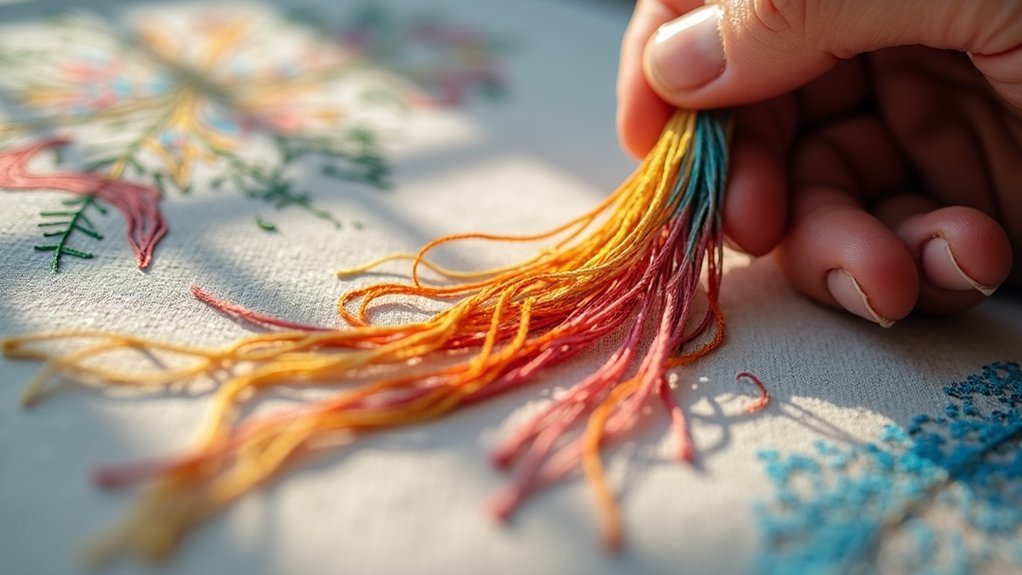

When embroidering on Aida, you’ll love its clear grid layout, making counting stitches a breeze. Use a stiff needle for easy gliding through its threads, sticking to the squares for best results. In contrast, linen’s natural fibers add texture and elegance, perfect for intricate designs but requiring more careful handling. The choice between Aida’s manageability and linen’s sophistication can shape your project’s outcome, so let’s explore these fabrics further for an informed decision.
Key Takeaways
- Aida’s clear grid layout simplifies counting stitches, making it ideal for beginners compared to the more complex texture of linen.
- Use sharp needles for both Aida and linen, but be cautious with linen’s natural slubs to avoid fraying.
- Stick to whole stitches on Aida; fractional stitches can be challenging, while linen allows for more detailed stitching techniques.
- Aida’s stiffness provides easier handling, while linen’s soft drape enhances the elegance of intricate designs.
- Choose Aida for straightforward projects and linen for heirloom-quality embroidery that requires precision and skill.
Understanding Aida Fabric for Embroidery
Aida fabric is a beloved choice among embroidery enthusiasts, especially for those just starting out. Made from 100% cotton, it features a grid layout with evenly spaced threads, perfect for cross stitch fabrics.
With thread counts ranging from 6 to 20 stitches per inch, the 14-count is the most common, allowing for easy counting and placement of stitches. The distinct squares, marked by four visible holes, help reduce miscounts while using embroidery floss.
You can also explore various colors and types, including Magic Aida for beginners, making it an ideal fabric to use for your stitching journey.
The Advantages of Using Aida for Beginners
When you’re just starting your embroidery journey, choosing the right fabric can make all the difference, and Aida stands out as a top choice for beginners.
Aida cross stitch fabric boasts a clear grid layout, making it easy to see and count your stitches accurately. The most common count, 14, offers a manageable size for simple designs, ensuring you have a rewarding experience.
Made from 100% cotton, Aida’s stiff structure allows for effortless handling while stitching. Its coarse finish is ideal for basic patterns, minimizing complications and helping you build confidence as you serve others through your beautiful creations.
Techniques for Stitching on Aida Fabric
When you start stitching on Aida fabric, the grid layout makes it easy to count your stitches and find your needle’s place.
Using a sharp needle is essential; it’ll glide through the threads without fraying, ensuring a clean finish.
For best results, stick to the squares and remember that while Aida’s coarser weave is beginner-friendly, intricate fractional stitches can be tricky.
Aida Stitching Basics
Although you might be new to embroidery, mastering the basics of stitching on Aida fabric can be an enjoyable and rewarding experience.
Aida features a grid layout, allowing you to easily count threads and stitch directly into the squares, making it perfect for beginner projects. Most commonly, you’ll use 14-count Aida, achieving 14 crosses per inch for detailed designs.
A sharp needle is essential for clean edges, and while fractional stitches can be tricky, they can be managed within the grid. The fabric’s stiffness guarantees your stitches remain consistent, enhancing the beauty of your finished piece.
Needle and Thread Tips
Choosing the right needle and thread is essential for achieving beautiful results when stitching on Aida fabric. Opt for a sharp tapestry needle, size 24 to 26, to easily pierce the fabric and create clean holes.
For beginners, use 6 to 14 count Aida, as larger holes simplify counting and placement. Employ 2 to 3 strands of embroidery floss for fuller coverage—this enhances your stitches while respecting the fabric’s integrity.
Exploring Linen Fabric for Embroidery
Linen fabric, crafted from natural flax fibers, offers an exquisite choice for embroidery, particularly if you’re aiming for heirloom-quality pieces. Its unique texture, with natural slubs and irregularities, adds character but requires you to be careful when stitching. Most commonly, thread counts range from 28 to 50, accommodating intricate hand embroidery designs that showcase your skill.
| Thread Count | Design Complexity | Stitching Ease |
|---|---|---|
| 28 | Moderate | Challenging |
| 36 | Advanced | Intermediate |
| 50 | Highly Intricate | Advanced |
Benefits of Choosing Linen for Your Projects
Choosing linen for your embroidery projects gives you superior stitch definition, allowing your designs to pop with clarity.
The unique texture of linen not only enhances the visual appeal with its natural slubs but also accommodates versatile project scaling, making it suitable for both intricate and larger designs.
You’ll find that stitching on linen elevates your work, transforming it into a true masterpiece.
Superior Stitch Definition
When you seek to elevate your embroidery projects, opting for linen can greatly enhance the stitch definition.
Linen’s high thread count, typically 28 to 40, offers a smoother surface, allowing for refined, intricate designs that truly stand out. You’ll find that each cross stitch appears more vibrant and defined, leading to an overall professional finish.
The fabric’s natural variations lend unique character, but they demand careful counting for accurate placement.
With linen, you can explore a wider variety of stitch types, releasing your creativity and providing superior stitch definition that transforms your projects into heirloom-quality treasures.
Enhanced Visual Appeal
While exploring fabric options for your embroidery projects, you’ll find that opting for linen can markedly enhance the visual appeal of your finished work. Linen offers a polished and elegant finish, making your stitches appear more defined and vibrant. Its natural slubs add character, while high thread counts enable intricate detailing. The smoother surface supports advanced stitching techniques, showcasing your creativity beautifully.
| Feature | Linen Benefits |
|---|---|
| Visual Appeal | Polished, vibrant designs |
| Texture | Unique slubs enhance character |
| Detail Capability | High thread counts for intricacy |
Choose linen for striking embroidery!
Versatile Project Scaling
Linen fabric excels in providing versatile project scaling, allowing you to adapt your embroidery designs with ease. Its higher fabric counts, typically ranging from 28 to 40 stitches per inch, enable intricate creations.
Here are three key benefits:
- Flexibility: Stitch over two threads for larger cross-stitch designs or one for fine details.
- Polished Finish: The smooth surface enhances the appearance, perfect for heirloom projects.
- Compatibility: Works well with various stitch types, ensuring quality results across different scales.
Choose linen for your next project and enjoy the elegant finish and adaptability it offers!
Stitching Techniques on Linen Fabric
As you begin your embroidery journey with linen fabric, mastering the stitching techniques is essential for achieving a polished finish. Count over two threads for each cross stitch to guarantee accuracy, especially with higher thread count linens. Use a sharp needle to prevent jagged edges, and be careful when stitching around natural irregularities, known as slubs. For best results, consider a backing fabric to improve grip and stitch quality.
| Stitching Technique | Description |
|---|---|
| Counting Threads | Count over two threads for accuracy. |
| Needle Selection | Use a sharp needle for clean stitches. |
| Backing Fabric | Helps improve stitch quality on linen. |
Comparing the Experience: Aida vs. Linen
When you plunge into the world of embroidery, choosing between Aida and linen can greatly influence your experience. Here’s what you should consider:
- Ease of Use: Aida fabrics feature a structured grid, making it beginner-friendly for cross stitchers.
- Texture and Finish: Linen, woven from flax, offers a soft, elegant drape, perfect for intricate designs, but requires careful counting.
- Count Variations: Aida counts range from 6 to 20, while linen boasts 28 to 40, ideal for detailed work.
Both are great fabrics; however, Aida is often more approachable, while linen shines in heirloom-quality projects. Choose wisely!