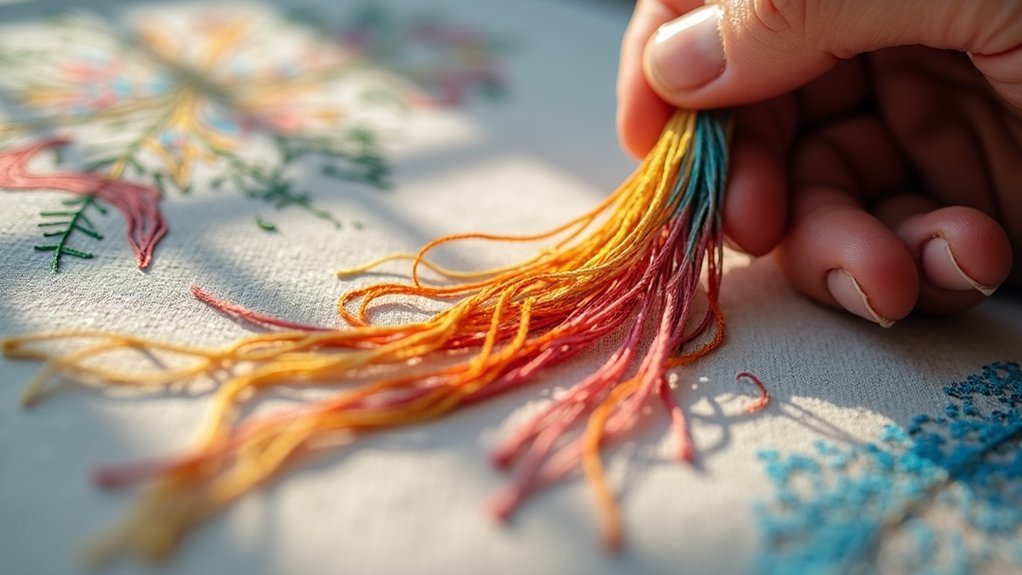

To design original embroidery patterns, start by choosing the right tool like Canva for beginners or Adobe Illustrator for advanced features. Opt for a limited color palette to keep things fresh and legible. Experiment with techniques like tracing designs using lightweight paper or a water-soluble pen. When stitching, make certain your fabric is hooped tightly and contrast your thread colors for impact. Let nature and cultural art inspire your creations, but there’s so much more to explore and innovate!
Key Takeaways
- Explore various design tools like Canva or Adobe Illustrator to create unique embroidery patterns tailored to your style.
- Limit your color palette and use larger shapes for clarity and legibility from a distance.
- Utilize tracing techniques, such as carbon transfer paper or water-soluble pens, to accurately transfer designs onto fabric.
- Experiment with stitch types and thread colors that contrast with your fabric to enhance the visual appeal of your patterns.
- Draw inspiration from adult coloring books, nature, or cultural art to develop original and diverse motifs.
Choosing the Right Design Tool
When it comes to choosing the right design tool for your embroidery patterns, how do you know which one suits your needs best?
If you want to design your own custom creations without hassle, Canva’s user-friendly interface is perfect.
For those with experience, Adobe Illustrator offers advanced features, although it might require a steeper learning curve.
Inkscape is a fantastic free alternative for vector graphics, while Printful Design Maker simplifies the process specifically for embroidery.
If you’re looking for precision, embroidery software like Hatch allows you to create your design with both auto-digitizing and manual control over stitch properties.
Color Selection for Your Patterns
After selecting the right design tool, it’s time to bring your embroidery patterns to life with thoughtful color selection.
Embrace a limited color palette for design simplicity, ensuring clarity and impact. Here are three tips to guide your choices:
Embrace a limited color palette for impactful designs that prioritize clarity and simplicity.
- Opt for larger shapes and bolder colors for better legibility from a distance.
- Experiment with dyeing thread to create unique gradients and smooth changes.
- Avoid small text; keep it at least 0.25 inches in height and 0.05 inches thick.
Techniques for Transferring Designs
Transferring your designs with precision is essential for creating stunning embroidery patterns that truly stand out.
Start by using lightweight trace paper to draw your design, then pin it to the canvas and stitch through both layers for an accurate transfer.
Alternatively, grab a water-soluble pen to directly sketch your design on the canvas, adding a personal touch.
For intricate patterns, carbon transfer paper makes replicating designs easy.
If you’re working on detailed artwork, print it onto self-adhesive water-soluble stabilizer, allowing for a seamless stitch.
Finally, utilize a lightbox or sunny window for clear tracing, ensuring your design shines.
Tips for Stitching Your Patterns
With your designs perfectly transferred onto the fabric, it’s time to bring them to life through stitching. Here are some tips to guarantee your embroidery shines:
- Securely hoop your fabric to prevent shifting, keeping your design aligned.
- Choose thread colors that beautifully contrast with your fabric, enhancing visibility.
- Use various stitch types, like satin stitches for outlines and fill stitches for larger areas, to add depth.
Regularly check your tension settings to avoid puckering, guaranteeing smooth, even stitches.
Exploring Unique Design Inspirations
Have you ever wondered where to find inspiration for your next embroidery project? You can create your own embroidery by exploring various sources. Try adult coloring books for intricate designs, or let nature’s colors and textures guide you. Here’s a table to spark your imagination:
| Source | Inspiration Type | Unique Element |
|---|---|---|
| Adult Coloring | Intricate Line Drawings | Traceable, adaptable patterns |
| Nature | Shapes & Textures | Organic motifs |
| Cultural Art | Folk/Indigenous Patterns | Respectful reinterpretation |
| Abstract Design | Experimentation | Free-form creativity |
Design directly from these ideas, and you’ll discover different embroidery styles!