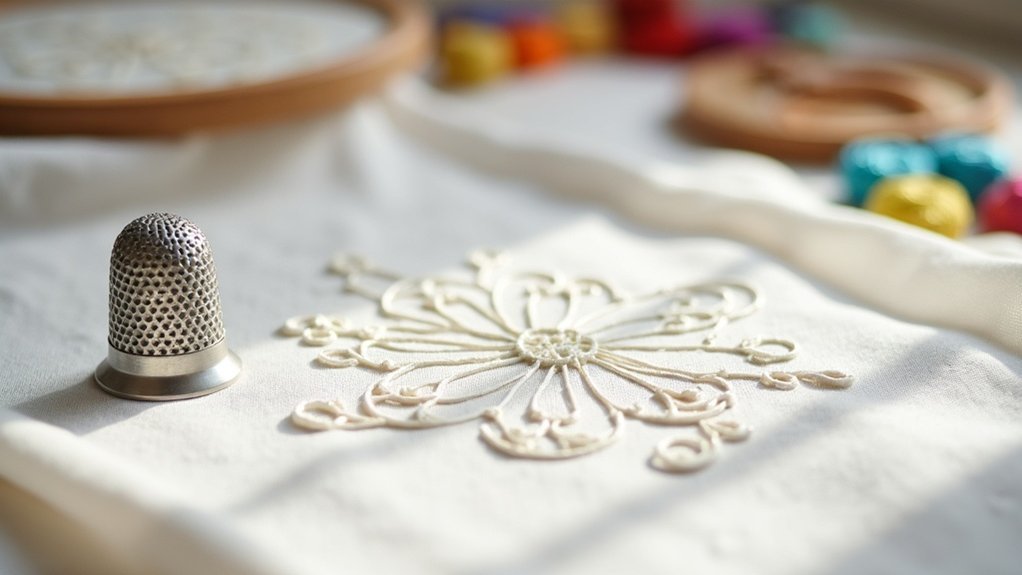
To start whitework embroidery, choose a high-count pure white muslin for its accessibility. Gather essential supplies like white threads, an embroidery hoop, and fabric-appropriate needles. Transfer your design by tracing onto the fabric, ensuring it’s smooth and taut. Master basic stitches like backstitch, satin stitch, and French knots to build your technique. Focus on creating texture through varied stitch lengths and filling shapes evenly. These steps will guide your artistry, revealing even more intricate techniques ahead.
Key Takeaways
- Select high-count pure white muslin or fine linen for optimal embroidery results, avoiding synthetic blends.
- Learn essential stitches like backstitch, satin stitch, and French knots to build your technique.
- Use a proper embroidery hoop to maintain fabric tension and ensure high-quality stitching.
- Transfer your design carefully using blue transfer pens or Saral-type paper for accurate placement.
- Create texture by varying stitch lengths and combining different stitch types for visual interest.
Understanding Whitework Embroidery
Whitework embroidery is a unique art form that captivates with its intricate designs created using white thread on white fabric. This technique emphasizes texture over color, allowing you to investigate various embroidery techniques like drawn thread work, pulled work, and satin stitches.
You’ll find that common stitches such as backstitch, stem stitch, and French knots are simple enough for beginners to master. Whitework isn’t only accessible but also relatively inexpensive, requiring minimal supplies.
As you explore this elegant craft, you’ll appreciate how it beautifully serves to enhance fabrics and create meaningful gifts for others in your community.
Selecting the Right Fabric
Choosing the right fabric is essential for successful whitework embroidery, as it directly impacts your stitching experience and the final outcome. Here are some key considerations:
- High-count pure white muslin for beginners—affordable and easy to stitch.
- Fine linen for advanced projects—provides a sturdy base for intricate techniques.
- Batiste, organdy, and lawn—lightweight options conducive to whitework.
- Natural fibers over synthetic—ensure better manipulation and stitching quality.
- Avoid blended fabrics—maintain integrity and quality of your embroidery work.
Selecting the right fabric enhances your skills and allows you to create beautiful, lasting pieces for others to cherish.
Essential Supplies for Beginners
To get started with whitework embroidery, you’ll need a few essential supplies that set the foundation for your projects.
Choose high-quality fabric like fine linen or pure white muslin, and gather a selection of white threads, such as coton a broder for its sheen.
Don’t forget a hoop to maintain fabric tension and needles that match your thread and fabric for best results.
Fabric Choices for Beginners
When beginning your journey into whitework embroidery, selecting the right fabric is essential for a successful experience. Here are some fabric choices that work well for beginners:
- High-count, pure white muslin for affordability and ease
- Fine linen for durability in advanced projects
- Lightweight batiste for easy handling
- Organdy for a crisp texture
- Lawn for a smooth surface
Natural fibers are preferred, as they improve stitch handling and maintain quality.
Avoid synthetic blends to guarantee ideal results and ease of stitching.
Choosing the right fabric will set you up for success in your white embroidery endeavors.
Thread Types and Options
While selecting the right thread is essential for achieving beautiful whitework embroidery, understanding the various types available can elevate your projects considerably.
Coton a broder is the go-to choice, known for its sheen and non-divisible nature, perfect for various stitch techniques. You might also consider regular stranded cotton, pearl cotton, or cotton floche for different textures.
If your piece requires laundering, stick with cotton threads to maintain integrity. For cost-effective options, white silk from YLI offers a smooth finish.
Experimenting with these options helps you refine your style and enhance your white thread on white designs.
Basic Tools Required
Having the right tools at your fingertips makes a significant difference in your whitework embroidery experience. Here’s a list of essential supplies you’ll need:
- High-count, pure white muslin or fine linen fabric
- Embroidery hoop for fabric stability
- 6-stranded embroidery floss or silk thread
- Sharp or embroidery needles for smooth stitching
- Blue transfer pens or Saral-type transfer paper for design placement
These tools guarantee a seamless stitching process and allow you to create beautiful pieces.
Always test your fabric for wash-out capability when using transfer methods to avoid damage while achieving accurate designs.
Happy stitching!
Basic Stitch Techniques
Now that you have your supplies ready, it’s time to focus on essential stitches that form the backbone of whitework embroidery.
You’ll want to choose the right thread types to complement your stitches, as this choice greatly affects the overall appearance of your work.
Understanding common stitch applications will allow you to create intricate designs and textures, enhancing your embroidery skills considerably.
Essential Stitches Overview
Understanding the essential stitches in whitework embroidery is crucial, as each stitch serves a unique purpose that enhances the overall design.
Here are some key stitches you’ll use:
- Backstitch for outlining and solid lines
- Stem stitch for smooth, twisted curves
- Satin stitch to fill shapes with a flat finish
- Chain stitch for decorative borders and outlines
- Buttonhole stitch for edges and raised effects
Mastering these stitches, particularly the satin and chain stitches, will elevate your work, providing texture and dimension.
Practice each technique to develop your skills and create beautiful, intricate designs that serve your artistic vision.
Choosing Thread Types
When you choose thread types for whitework embroidery, the right selection can greatly impact the final appearance of your project. Coton a broder is ideal for its sheen and polished finish. Other options like regular stranded cotton, pearl cotton, and cotton floche offer unique textures. Remember, thread weights matter; thicker threads create chunkier knots, while finer threads yield delicate details. For laundered pieces, stick with cotton to preserve longevity. Experiment with different threads to develop your unique style.
| Thread Type | Characteristics |
|---|---|
| Coton a broder | Sheen, non-divisible, polished |
| Pearl cotton | Soft, textured, versatile |
| Cotton floche | Light, fluffy, great for filling |
Common Stitch Applications
Selecting the right thread types sets the stage for effective stitch applications in whitework embroidery.
Here are some common embroidery stitches to enhance your skills:
- Backstitch: Perfect for outlining with a defined edge.
- Stem Stitch: Adds a decorative twist for elegant lines.
- Satin Stitch: Ideal for smoothly filling shapes; guarantee even stitching.
- Chain Stitch: Creates textured lines, great for borders or floral designs.
- Buttonhole Stitch: Versatile for finishing edges and intricate shapes.
Mastering these techniques will elevate your whitework, allowing you to serve others with your beautifully crafted pieces.
Transferring Your Design
To successfully transfer your design onto fabric, you’ll want to start by placing transfer paper face down on the ground fabric, making sure the ink side is in direct contact with the surface.
Using a pen or rotary wheel, trace over the design, applying even pressure for a clear transfer. Make certain the fabric is smooth and taut to prevent any shifting during the process.
Before removing the transfer paper, check that the design is fully visible. It’s wise to test your method on a scrap piece of fabric to make sure the ink washes out if you plan to remove it later.
Hooping and Securing Fabric
Before you begin stitching, properly hooping and securing your fabric is essential for achieving precise results in whitework embroidery.
Follow these steps to guarantee a tight and stable working surface:
- Choose a comfortable fabric hoop that fits your hands.
- Place the fabric in the hoop, making sure it’s taut but not overly stretched.
- Tighten the hoop’s outer ring evenly for consistent tension.
- Check the alignment of your design after hooping.
- Adjust as necessary before starting your work.
With careful hooping, you’ll prevent shifting and maintain stitch quality, ensuring your whitework embroidery turns out beautifully.
Creating Texture and Filling Shapes
While you explore the art of whitework embroidery, creating texture and filling shapes is essential for adding depth and visual interest to your designs.
Utilize varying stitch lengths and types—combine long satin stitches with short French knots for dynamic texture. For filling shapes, make sure satin stitches are closely placed to prevent fabric gaps.
Enhance depth by alternating filling techniques; outline areas with straight overcast stitches before filling. Maintain even thread tension for a smooth appearance.
Don’t hesitate to layer stitches, like adding pulled thread over satin stitch, to elevate your piece’s intricate textures and overall visual impact.