To keep even tension in tambour embroidery, secure your fabric in a sturdy frame, ensuring it’s taut and wrinkle-free. Use appropriate fabrics and adjust thread tension frequently while stitching. Monitor your stitch length for consistency, and control your grip to maintain thread tautness without over-tightening. Regularly inspect your work for uniformity, feeling for puckering as you go. As you master these techniques, you’ll enhance your embroidery skills and improve your overall results. There’s more to discover ahead!
Key Takeaways
- Maintain consistent tension by regularly checking stitches and adjusting as needed to prevent puckering and ensure uniform appearance.
- Use a sturdy embroidery frame to keep the fabric taut and minimize movement during stitching.
- Choose appropriate fabrics and ensure they are free of wrinkles to avoid tension disruptions.
- Control the working thread tautness; avoid excessive tightness to maintain even stitch lengths.
- Regularly inspect your work visually and by touch to identify and correct any tension issues early.
Understanding the Importance of Tension in Tambour Embroidery
When you commence your tambour embroidery journey, understanding the importance of tension becomes vital, as it directly affects the quality of your work.
Maintaining even tension guarantees your stitches—particularly the chain stitch—are uniform and visually appealing. Uneven tension can lead to puckering or loose loops, which detracts from your craftsmanship.
Even tension is crucial for uniform stitches, especially the chain stitch, to enhance the beauty of your embroidery.
Start by practicing with a single layer of fabric for better thread visibility. Regularly check your stitches during the process, adjusting tension as needed.
Developing muscle memory through repetition allows for those quick wrist movements essential to mastering your hook technique and achieving consistent tension in every project.
Choosing the Right Frame for Stability
A sturdy embroidery frame is essential for achieving stability in tambour embroidery, as it keeps your fabric taut and minimizes movement during stitching.
Choose a frame that suits your project size; a larger frame can complicate tension on smaller areas, while a smaller one may restrict movement on larger designs.
Consider a free-standing frame with clamps for easy access to both sides of your fabric. Securely pin or clamp your fabric to prevent slippage, ensuring an even tension throughout your work.
Regularly check and adjust the frame to maintain a smooth, stable surface for beautiful embroidery results.
Preparing Your Fabric for Optimal Tension
To achieve ideal tension in tambour embroidery, start by ensuring your fabric is securely held in a properly tensioned embroidery frame or hoop.
Select a fabric with an appropriate weave, like cotton bobbinet or silk chiffon, which offers stability.
Before you begin, make sure the fabric is free of wrinkles or creases; any irregularities can disrupt your tension.
If you’re working with larger or delicate pieces, consider using basting stitches to keep everything in place.
As you stitch, consistently check your tension, adjusting as needed to maintain that beautiful, uniform appearance throughout your project.
Techniques for Maintaining Consistent Stitch Lengths
Achieving consistent stitch lengths in tambour embroidery hinges on your ability to control several factors simultaneously. Focus on keeping your working thread taut but not overly tight, adjusting your grip as needed. Use a lightweight fabric for better visibility and practice varying your stitch lengths and speed. Regularly check your stitches to verify uniformity, catching tension issues early.
| Factor | Tip |
|---|---|
| Hook Size | Choose one that suits your fabric |
| Thread Tension | Maintain even tension, avoid pulling |
| Stitch Speed | Experiment to develop muscle memory |
An embroidery tutorial can help you refine these techniques.
Hand Positioning and Grip for Fluid Movements
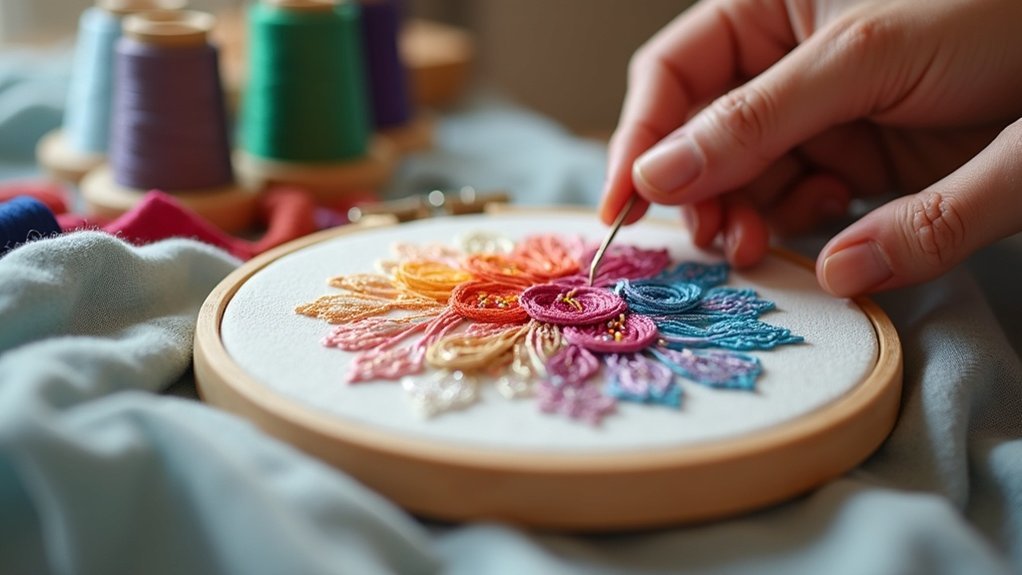
Proper hand positioning and grip are essential for achieving fluid movements in tambour embroidery. Maintain a relaxed grip on the tambour hook; this lets your wrist move freely without tension disrupting your stitching rhythm.
Position your non-dominant hand beneath the fabric to guide the thread, ensuring consistent tension as you work. Keep your hand and wrist neutral to prevent fatigue and uneven stitching.
Opt for quick, controlled wrist movements rather than large arm motions for precision. Regularly check the stitch appearance on both sides, adjusting your grip as needed to achieve that beautiful, uniform tension you desire in your hand embroidery.
Regularly Checking Your Work for Evenness
As you stitch, take a moment to visually inspect your work for stitch consistency; this simple act can reveal any tension issues before they escalate.
Adjust the thread tension as needed, ensuring each stitch lays flat and prevents unwanted puckering.
Observing Stitch Consistency
While you immerse yourself in the rhythmic motions of tambour embroidery, it’s essential to take moments to pause and assess your work.
Use a mirror or a close-up view to spot any discrepancies in stitch tension that might elude your eye from afar. Run your fingers along the stitched area to feel for unevenness or puckering, telling signs of tension variations.
Keep a steady grip on the tambour hook and guarantee your wrist movements remain consistent for uniformity.
Consider marking areas where tension falters, allowing you to focus on correcting these spots during your next passes, guaranteeing flawless embroidery.
Adjusting Thread Tension
To achieve even tension in tambour embroidery, it’s crucial to regularly check your work for consistency. As you create each basic chain stitch, examine both the front and back of your project.
Maintain gentle tension on the working thread; too tight can cause puckering, while too loose results in uneven stitches. Use your needle to wrap the thread carefully and manipulate the hook with precision.
Don’t hesitate to adjust the tension by pulling or loosening the thread between stitches, especially when switching fabrics. Periodically stop to assess your progress, ensuring a balanced appearance throughout your embroidery journey.
Preventing Fabric Puckering
Ensuring your fabric lays flat without puckering is essential for achieving polished tambour embroidery. Regularly check your work to maintain even tension and prevent distortion.
Here’s how to keep fabric puckering at bay:
- Inspect the Back: Pause and examine the back of your work for flat stitches.
- Balance Tension: Keep your thread taut but flexible, avoiding excessive tightness.
- Gentle Movements: Use gentle wrist movements, ensuring your hook is facing the right direction and your non-dominant hand supports the fabric.
Building Muscle Memory Through Practice
To master tambour embroidery, you need to focus on consistent hook movement and thread tension techniques.
As you practice, your hands will begin to remember the rhythm, allowing for fluid motions that create even stitches.
Regular, short sessions will help solidify this muscle memory, making your stitching feel effortless and precise.
Consistent Hook Movement
Practicing consistently is key to mastering tambour embroidery and achieving even tension in your stitches. Focus on developing muscle memory through consistent hook movement, ensuring your grip remains relaxed for smooth movements.
Here are three essential tips to enhance your practice sessions:
- Stitch in one direction to cultivate fluidity before exploring varied patterns.
- Utilize wrist movements instead of arm movements; this promotes a steady rhythm.
- Record your sessions to pinpoint areas for improvement, enhancing tension control.
Thread Tension Techniques
While mastering tambour embroidery, you’ll quickly realize that thread tension is the backbone of your technique, influencing the overall appearance of your work. Start with loose weave fabrics, focusing on maintaining even tension through practice and muscle memory. Employ gentle pressure with your hook and consistently hold the thread beneath the fabric to achieve uniform stitches. Regularly check your loop sizes for consistency, guaranteeing a polished finish. As you build confidence, gradually shift to opaque fabrics, enhancing your skills further.
| Practice Focus | Key Techniques |
|---|---|
| Loose Weave Fabrics | Improve visibility |
| Gentle Pressure | Control stitch tightness |
| Uniform Loop Sizes | Guarantee polished appearance |
| Consistent Thread Hold | Prevent puckering |
| Shift to Opaque | Challenge your skills |