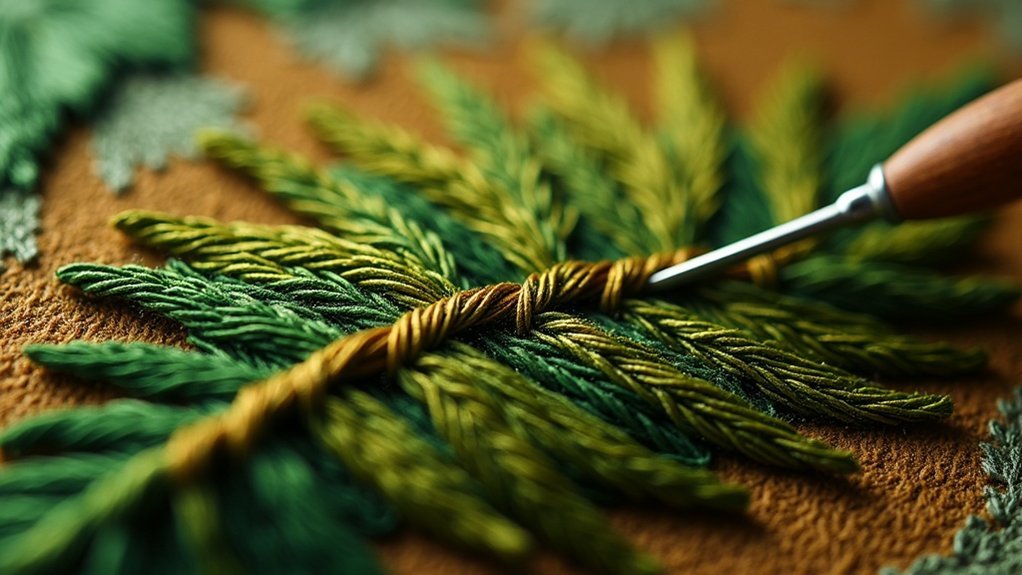
To create the Fishbone Leaf Stitch in embroidery, start by bringing your needle up at the leaf’s tip. Make a small straight stitch for the spine, then alternate diagonal stitches on each side, crossing over the spine. Keep your stitches close for a smooth look and follow guidelines for curves to maintain symmetry. Choose a suitable thread to enhance the finish. With practice, you’ll master this beautiful stitch. You’ll discover even more tips and variations as you explore further!
Key Takeaways
- Begin by bringing the needle up at the tip of the leaf and creating a central straight stitch for the spine.
- Alternate diagonal stitches on each side of the spine, crossing over the centerline for texture.
- Use guidelines for curves to maintain symmetry and ensure stitches remain aligned.
- Choose an appropriate thread, like cotton floche or wool, for a polished finish.
- Practice spacing and consistency in stitch placement for a smooth and professional look.
Understanding Fishbone Stitch
Understanding the Fishbone Stitch is key to adding beautiful, textured elements to your embroidery projects. This filling stitch creates the look of leaves and feathers with its overlapping diagonal stitches forming a central spine.
Mastering the Fishbone Stitch enhances your embroidery with stunning textures that mimic leaves and feathers.
By alternating slanted stitches from both sides, you’ll achieve a smooth finish. The Fishbone Stitch, part of the satin stitch family, is versatile for various shapes, including floral designs.
You can also explore variations like the Open Fishbone Stitch for different textures. Choosing the right thread, like cotton floche for softness or wool for quicker filling, enhances the overall appearance of your work.
Happy stitching!
Step-by-Step Guide to Fishbone Leaf Stitch
To start your Fishbone Leaf Stitch, you’ll want to bring your needle up at the leaf’s tip and create a spine with a small straight stitch.
As you work your way down, alternate your side stitches, crossing over the centerline for a beautiful, filled effect.
Don’t forget to use a guideline for curves, and choose the right thread for a polished finish!
Starting the Fishbone Stitch
As you plunge into the Fishbone Stitch, begin by bringing your needle up at the tip of your leaf shape; this establishes a clear starting point for your embroidery project.
Follow these steps to create your foundation:
- Create a small straight stitch down the center to serve as the spine.
- Bring your needle up to the left of the top stitch, inserting it down on the centerline to form your first side stitch.
- Alternate sides by bringing the needle up on the right and inserting it down the centerline, ensuring your stitches stay close together for a smooth appearance.
Stitching Techniques and Tips
Mastering the Fishbone Leaf Stitch can elevate your embroidery skills considerably.
Begin by bringing the needle up through the leaf’s tip, making your first stitch down the center to form the spine. Next, alternate side stitches: come up to the left, then down on the centerline, and repeat on the right. Confirm your stitches lie close together to avoid gaps.
For a polished finish, keep your stitch placement consistent, adjusting for curves if necessary. Don’t forget to practice the stabbing technique—insert the needle at a right angle for accuracy. This skill will enhance your hand embroidery projects beautifully!
Tips for Perfecting Your Fishbone Stitch
Perfecting your fishbone stitch can be a rewarding journey, especially when you focus on a few key techniques. Here are some tips to elevate your embroidery:
- Maintain close spacing between stitches to create a smooth, tidy appearance, minimizing gaps in your design.
- Practice the stabbing technique for accurate stitch placement, perfect for beginners.
- Draw a line for guidance, especially for curved shapes, ensuring stitches remain symmetrical and aligned.
Experiment with different thread types, like cotton floche for softness or wool for quicker filling, to enhance your fishbone stitch and achieve the desired texture in your beautiful creations.
Variations: Open and Raised Fishbone Stitches
While exploring the world of embroidery, you’ll find that variations like the Open and Raised Fishbone Stitches can add unique dimensions to your projects. The Open Fishbone Stitch offers an airy look with sparse diagonal stitches, creating a lovely border effect. In contrast, the Raised Fishbone Stitch builds depth by crossing diagonal stitches over a cushion of preliminary stitches. Both styles allow for creative stitch placement, enhancing your designs.
| Stitch Type | Description | Dimensionality |
|---|---|---|
| Open Fishbone Stitch | Sparse, airy diagonal stitches | Low |
| Raised Fishbone Stitch | Diagonal stitches creating depth | High |
| Design Flexibility | Adjust stitch placement for unique patterns | Variable |
Creative Uses for Fishbone Stitch in Patterns
Fishbone Stitch can transform your embroidery projects in countless creative ways. This versatile stitch, part of the stitch family, is used to create stunning effects in various patterns.
The Fishbone Stitch is a versatile technique that elevates your embroidery projects with stunning effects.
Consider these ideas:
- Floral Designs: Use Fishbone Stitch to fill the leaves of flowers, like the Mt. Laurel, enhancing botanical beauty.
- Seasonal Patterns: Capture autumn’s essence by crafting vibrant leaves in your Autumn Tree Pattern.
- Borders: Create a unique border effect by spacing the stitch appropriately, giving your projects an open look.
Embrace the Fishbone Stitch in your work; it truly works well in any design!
Resources for Further Learning
To truly master the Fishbone Leaf Stitch, tapping into a variety of resources can make all the difference in your learning journey.
Start by exploring online video tutorials that break down the Fishbone Stitch technique step-by-step, providing visual guidance.
Join community forums and social media groups where you can share projects and gather tips from fellow embroidery enthusiasts.
Don’t forget to refer to instructional books that cover various stitches, including pattern resources that showcase the Fishbone Stitch in designs.
Finally, consider attending local or online workshops for hands-on learning and expert feedback to enhance your skills and confidence.