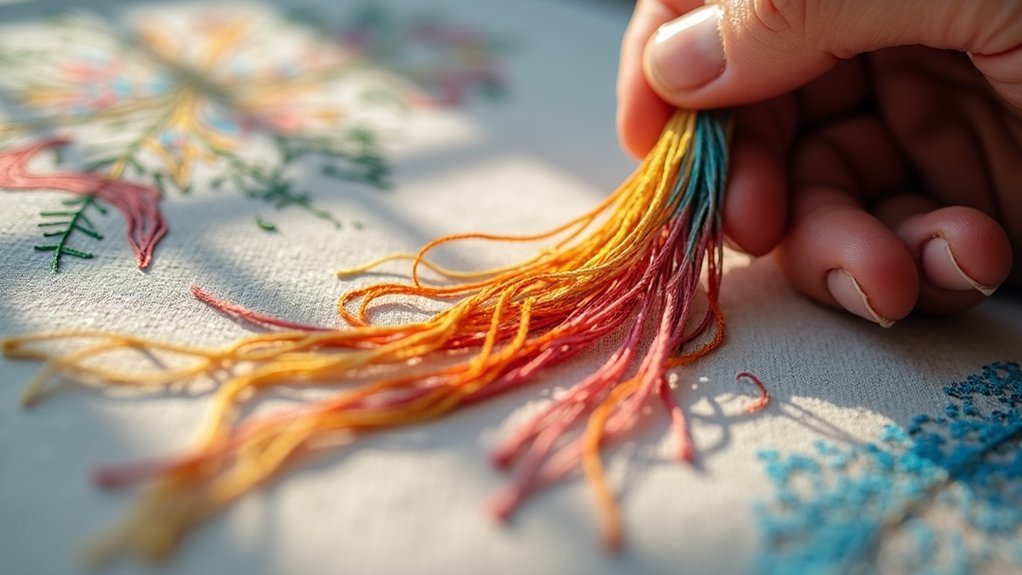
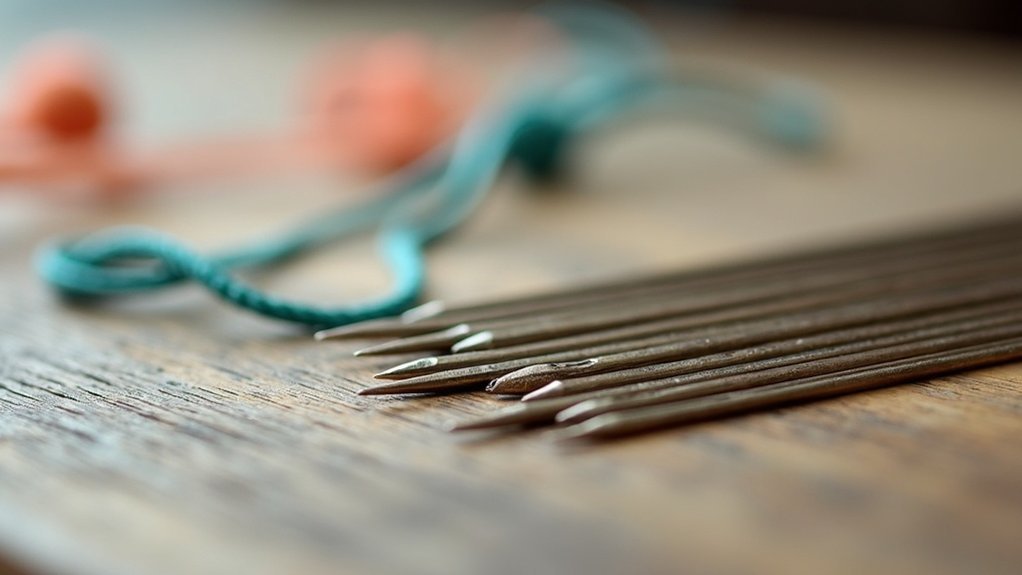
To choose embroidery needles by size, match the needle to your fabric and thread. For thicker fabrics, use larger needles (size 13-18), while lightweight fabrics require smaller needles. Consider thread thickness: size 5 needles suit six-strand floss, while sizes 7 or 8 work well for heavier threads. Test your needle on scrap fabric to verify compatibility. Optimizing needle size enhances your stitching quality and fabric integrity; more information awaits you as you explore further.
Key Takeaways
- Consider the fabric type; heavier fabrics require larger needles (size 13-18) while lightweight fabrics need smaller ones to avoid damage.
- Match the needle size to the thread thickness; larger needles are needed for thicker threads while finer needles are suitable for delicate threads.
- Choose the appropriate needle type based on the embroidery technique, such as crewel for surface work and tapestry for counted thread work.
- Verify the needle size corresponds with the number of thread strands used; size 5 needles work well for six-strand embroidery floss.
- Test the needle on scrap fabric to ensure compatibility and achieve the desired stitch quality before starting the actual project.
Understanding Needle Sizes and Their Importance
When choosing embroidery needles, understanding sizes and their significance is essential for achieving ideal results.
Needle sizes, indicated by numbers, range from 1 to 12; lower numbers represent larger needles. The correct needle size enhances stitching ease and improves the finish of embroidery projects.
Needle sizes, ranging from 1 to 12, significantly influence stitching ease and the quality of embroidery projects.
For instance, larger needles can create noticeable holes in fabric when used with fine threads. Selecting the right needle size also impacts the types of thread you can use—size 3 needles suit thicker threads, while sizes 8 to 12 are ideal for finer threads and delicate fabrics.
Prioritize needle size to guarantee fabric integrity and quality stitching.
Types of Embroidery Needles
Embroidery needles come in various types, each designed for specific stitching techniques and thread types.
Crewel needles, with their sharp tip and medium-long eye, are ideal for general surface embroidery.
Tapestry needles feature a blunt tip and long eye, perfect for counted thread work without piercing fabric threads.
Chenille needles have a sharp tip and long eye, making them suitable for thicker specialty threads.
Milliner needles, characterized by a small round eye and longer shaft, excel in fine thread techniques like sashiko.
Each type is available in different sizes, impacting compatibility with various fabrics and thread types for your embroidery project.
Factors to Consider When Choosing a Needle Size
Choosing the right needle size is essential for achieving ideal results in your embroidery projects. Several factors influence your decision:
- Fabric type: Heavier fabrics like denim need larger needles (size 13-18).
- Thread thickness: Thicker threads require larger needles to fit comfortably.
- Embroidery technique: Different techniques may demand specific needle sizes for peak performance.
- Correct needle size: Verify the size matches the number of thread strands—like using a size 5 needle for 3-4 strands of embroidery thread.
Recommended Needle Sizes for Different Threads
Selecting the appropriate needle size for various thread types directly affects the quality of your embroidery work.
For six-strand embroidery floss, a size 5 embroidery needle is recommended to effectively handle multiple strands without fraying.
When using heavier threads like pearl cotton in Sashiko, opt for a size 7 or 8 needle.
For fine threads in delicate embroidery, size 9 or 10 needles work best.
Tapestry needles for counted thread work range from size 13 to 28, while specialty threads like silk or metallics require a size 10 or 12 needle to guarantee smooth stitching without damaging fibers.
Matching Needle Size to Fabric Type
When choosing a needle, consider the weight of your fabric to guarantee peak performance.
Lightweight materials need smaller needles to avoid damage, while heavier fabrics require larger sizes to accommodate thicker threads.
Matching needle type and thickness with your fabric will enhance your stitching quality and prevent issues during your embroidery project.
Fabric Weight Considerations
To achieve ideal stitching results, it’s essential to match your needle size to the fabric weight. Consider these guidelines:
- Lightweight fabrics (silk, fine cotton) need smaller needles (60/8 to 70/10) to prevent damage.
- Medium-weight fabrics (quilting cotton, linen) work best with sizes 80/12 to 90/14 for balance.
- Heavier fabrics (denim, canvas) require larger needles (100/16 or 110/18) for proper penetration.
- The thickness of the embroidery thread influences needle selection; thicker threads need larger needles.
Using the correct needle size enhances stitch quality and prevents issues like skipped stitches or excessive hole visibility.
Needle Type Compatibility
Matching the right needle type to your fabric is just as important as choosing the correct size. For tightly woven fabrics, choose a sharp tip needle to guarantee smooth stitching.
For stretchy or loosely woven materials, a blunt tip tapestry needle prevents fabric threads from being pierced. Use a size 75/11 needle for lightweight fabrics, an 80/12 for medium-weight fabrics, and a 90/14 for heavyweight fabrics like denim.
When using embroidery floss, opt for a size 5 to 7 embroidery needle to accommodate multiple strands. Additionally, consider specific types, like chenille needles for thicker threads, enhancing needle size compatibility with embroidered fabrics.
Thread Thickness Matching
Choosing the right needle size directly impacts your embroidery’s success, especially when it comes to thread thickness.
Here’s how to match your needle to your fabric:
- Use size 5 embroidery needles for 3-4 strands of embroidery floss.
- Opt for larger needle sizes (like 3 or 5) for heavier threads to avoid fraying.
- For fine threads on lightweight fabrics, choose smaller needles (size 10-12) to prevent damage.
- Use tapestry needles with a blunt tip for thicker fabrics, while a sharp needle is best for tightly woven materials.
Always match needle size to fabric type for best results!
Tips for Selecting the Right Needle
When selecting the right embroidery needle, consider both the fabric type and the thread weight.
Thicker threads require larger needles to maintain proper tension, while finer threads benefit from smaller needles to avoid fraying.
Always test your chosen needle on scrap fabric to verify compatibility and ideal stitch quality.
Fabric Type Considerations
Selecting the right needle size for your fabric type is essential for achieving the best results in embroidery. Consider these fabric type considerations:
- For lightweight fabrics, use a size 75/11 needle to guarantee smooth stitching without damage.
- Medium-weight fabrics benefit from size 80/12 needles, balancing strength and precision.
- Heavyweight fabrics, like denim, require size 90/14 or 100/16 needles to accommodate thicker threads and prevent needle breakage.
- Use blunt-tipped tapestry needles for loose weaves to avoid snagging.
Thread Weight Compatibility
Understanding thread weight compatibility is essential for achieving ideal results in your embroidery projects.
Lighter threads, like 1-2 strands of embroidery floss, pair well with smaller needle sizes (9-12). For heavier threads, such as pearl cotton or wool, use size 3 needles to guarantee smooth passage through fabric and prevent needle damage.
Standard six-strand embroidery floss fits nicely with size 5 needles, accommodating multiple strands without fraying. Fine threads, like silk, require size 10-12 needles.
Always test needle and thread compatibility on scrap fabric to avoid excessive holes or snagging, guaranteeing a flawless finish on your projects.
Where to Buy Embroidery Needles
Finding the right place to buy embroidery needles can greatly impact your crafting experience. You have a variety of options, whether you prefer shopping in-store or online.
- Craft stores like Michaels and Joann offer well-known brands.
- Local quilting shops provide expert advice tailored to your projects.
- Online retailers like Amazon feature extensive selections, including bulk options.
- DIY embroidery kits often include needle packs, ideal for beginners.